AKI
2022
with edits in 2026
-> Service design
-> UI/UX Design
-> Marketplace Design
Timeline : 3 months
Team : 4 Designers
Role : Lead UX Designer
with edits in 2026
-> Service design
-> UI/UX Design
-> Marketplace Design
Timeline : 3 months
Team : 4 Designers
Role : Lead UX Designer
A trading platform for international students to buy, sell, and share resources sustainably based on the academic timeline.
-> Entry as part of IKEA’s Service Design Challenge. The goal was to reduce the repeated cycle of buying and discarding items that happens each year as new cohorts arrive and leave the UK.
Challenge
Rise in international students in the UK
In the 2022/23 academic year, a record 758,855 international students studied in the UK, which was a 12% increase from the previous year.
The buy–discard cycle
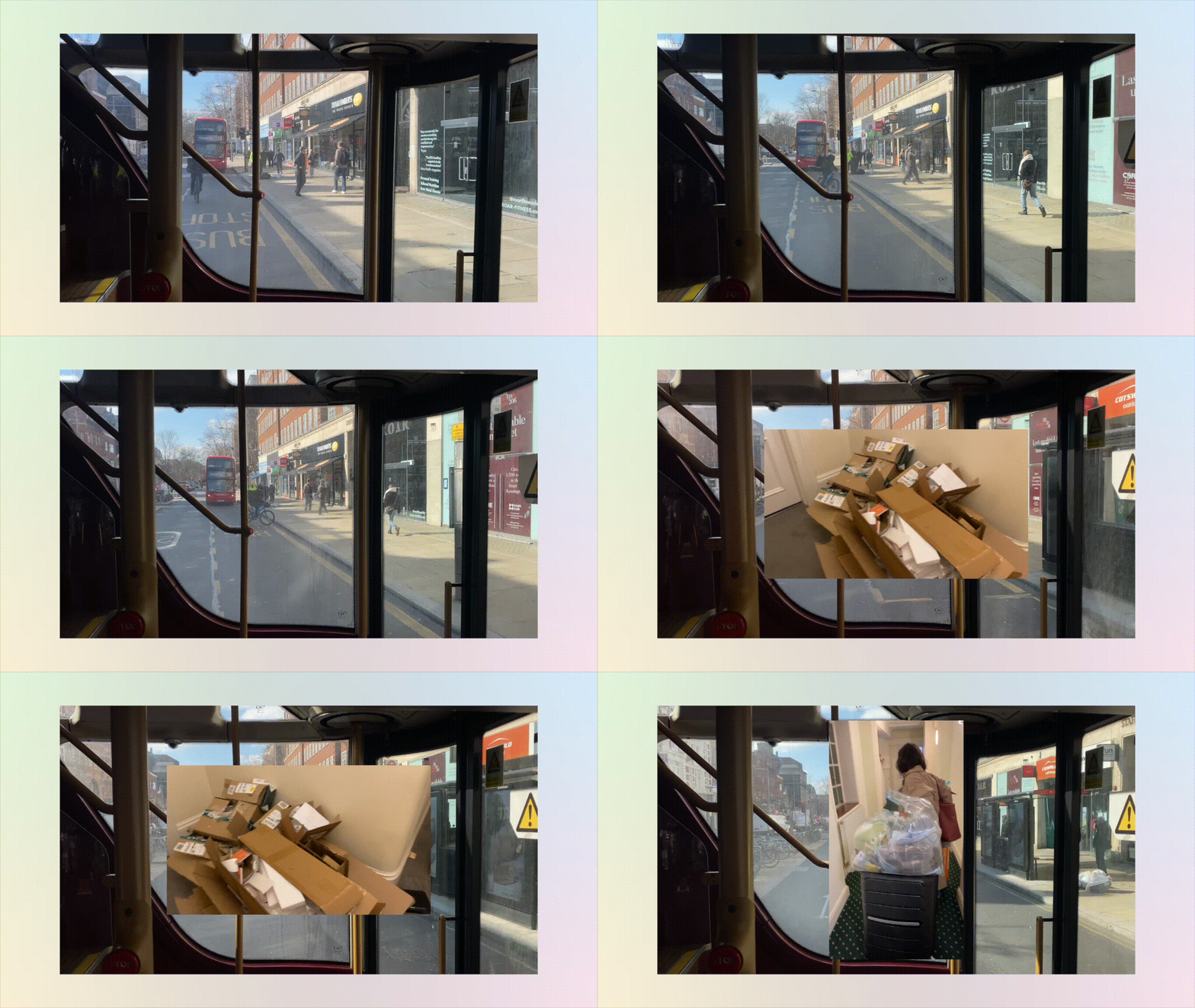
International students often move to London for 1–4 years. At the beginning of their studies, they purchase furniture and household essentials. When they leave, many struggle to resell these items and end up discarding them.This creates a predictable but inefficient system:
The challenge was to design a service that interrupts this cycle and supports more sustainable transitions.
In the 2022/23 academic year, a record 758,855 international students studied in the UK, which was a 12% increase from the previous year.
The buy–discard cycle
International students often move to London for 1–4 years. At the beginning of their studies, they purchase furniture and household essentials. When they leave, many struggle to resell these items and end up discarding them.This creates a predictable but inefficient system:
- Students buy new items for short-term use
-
Difficulty finding buyers within the same timeframe
-
Disposal becomes the easiest option
- The cycle repeats with each new academic year
The challenge was to design a service that interrupts this cycle and supports more sustainable transitions.
Research
How did we start?
(1) Field Research + User Interviews (n=3)We spoke with international students who were either actively moving or planning a move. Conducting interviews during this transition period helped us capture real frustrations. Fear of losing deposits, final year exams, farewell parties, all add to last-minute selling pressure.
(2) Online workshop (n=5)
We hosted an interactive session on Miro, using mapping exercises to uncover pain points around renting, selling timelines, and buyer availability. Many students struggle to sell because their entire cohort is moving out at the same time.
(3) Competitive Analysis (n=3)
To understand why students still discard items despite existing solutions, we reviewed the three most commonly used second-hand trading platforms identified in our initial research: Facebook Marketplace, Vinted, and university group chats. Although these platforms exist, they are not designed around the academic lifecycle. Timing misalignment and low trust within fragmented communities often lead to unsold items.
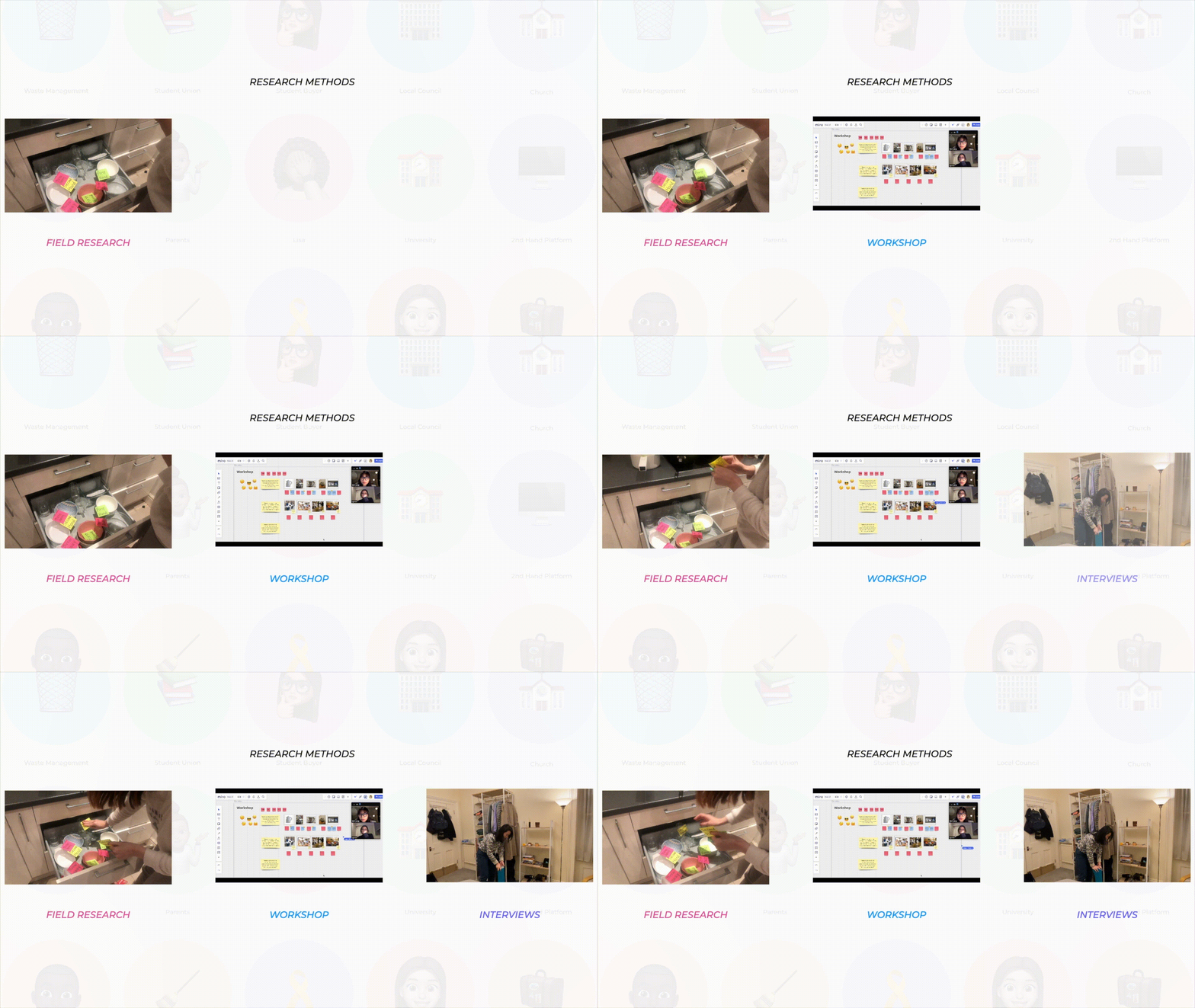
Research process ↓

Solution design
The problem isn’t access to marketplaces — it’s timing.
Buying and selling behaviour is closely linked to the academic calendar. Students who don’t plan ahead tend to buy new items, and when selling becomes urgent, disposal feels easier than coordination.
We developed a digital prototype called AKI — a marketplace designed around predictable student timelines.
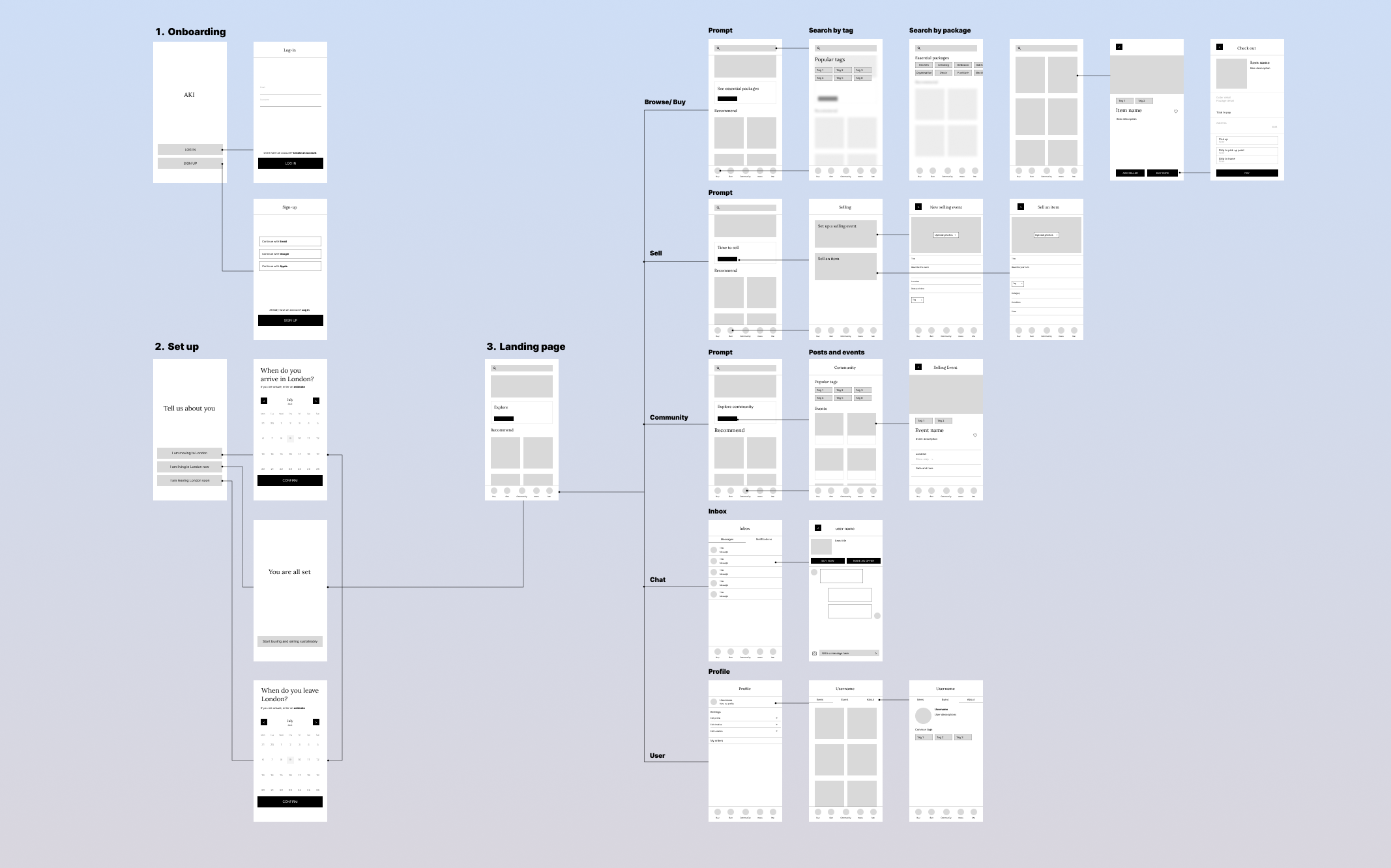
Users go through onboarding questions to indicate arrival, departure dates, and location, subjects, etc. This allows the platform to prioritise listings based on timeline, location and subject compatibility. We hope to improve relevance and increase the chances of successful buyer–seller matching.
(2) Time-sensitive notifications
We hope to encourage users to list items early before peak move-out season. We designed AKI around the academic calendar (September intake and June move-out period). The system anticipates high-demand windows and nudges users to list items early — before peak move-out season.
(3) New ways to sell
Our research showed that for last-minute sellers, in-person exchanges are often the most effective. When time is limited, students prefer quick, reliable transactions. In addition to online listings, the platform includes a feature for hosting community selling events. These structured events create straightforward, high-trust exchange opportunities and strengthen the sense of community within each cohort.
Buying and selling behaviour is closely linked to the academic calendar. Students who don’t plan ahead tend to buy new items, and when selling becomes urgent, disposal feels easier than coordination.
We developed a digital prototype called AKI — a marketplace designed around predictable student timelines.
Feature Highlights
(1) Student profile customisationUsers go through onboarding questions to indicate arrival, departure dates, and location, subjects, etc. This allows the platform to prioritise listings based on timeline, location and subject compatibility. We hope to improve relevance and increase the chances of successful buyer–seller matching.
(2) Time-sensitive notifications
We hope to encourage users to list items early before peak move-out season. We designed AKI around the academic calendar (September intake and June move-out period). The system anticipates high-demand windows and nudges users to list items early — before peak move-out season.
(3) New ways to sell
Our research showed that for last-minute sellers, in-person exchanges are often the most effective. When time is limited, students prefer quick, reliable transactions. In addition to online listings, the platform includes a feature for hosting community selling events. These structured events create straightforward, high-trust exchange opportunities and strengthen the sense of community within each cohort.