← Home
AI x Design Lab Research
2023-2025
-> Design Research
-> Artificial Intelligence
-> Health Tech
-> Design Research
-> Artificial Intelligence
-> Health Tech
Use of Artificial Intelligence to improve physical well-being.
The brief
This project looks at how AI can be leveraged to design inclusive digital health interventions that address lifestyle-related back pain. I used qualitative research methods, including interviews, observations, and workshops to uncover insights which directly informed design intent.

Research Overview
Back pain can happen regardless of age or ability. As we continue to adopt new ways of working (home, remote and hybrid), this presents challenges for workers to manage their back health. In the UK, the British Chiropractic Society states that 49% of people in the UK experience back or neck pain on a weekly basis, with 20% pointing to work as a key trigger.
This research aims to develop a personalised health intervention rather than general advice for backs through inclusive design research and application of AI. Read more about the research methodologies and insight in this paper (page 64).
This research aims to develop a personalised health intervention rather than general advice for backs through inclusive design research and application of AI. Read more about the research methodologies and insight in this paper (page 64).
1. Observations
Our observations research themes:

(1) Photo diary
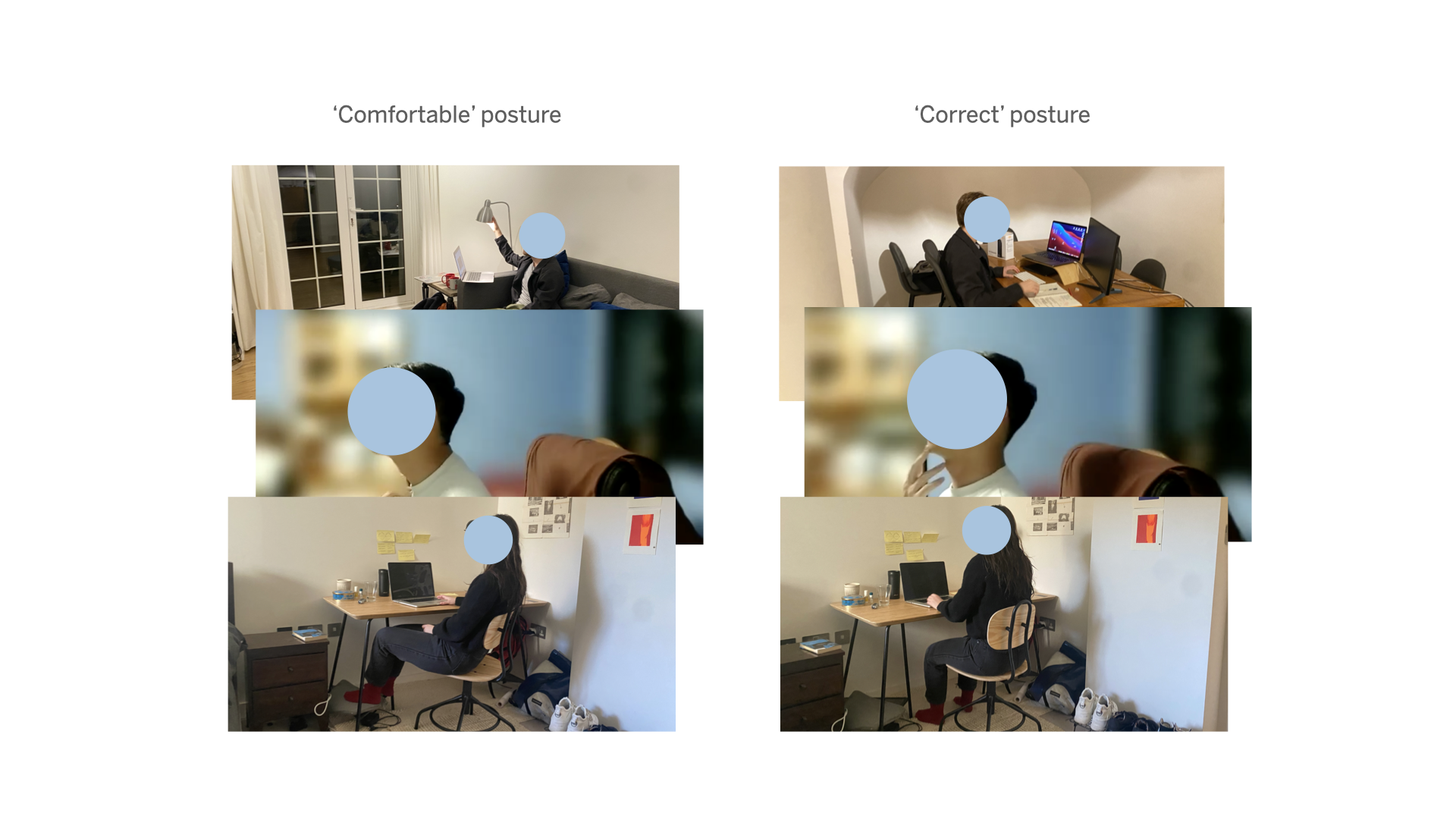
We collected images of where participants worked, how they sat in different environments, and how their posture shifted across contexts — home, office, commute. This gave us unfiltered insight into real-world behaviour rather than self-reported habits.
We collected images of where participants worked, how they sat in different environments, and how their posture shifted across contexts — home, office, commute. This gave us unfiltered insight into real-world behaviour rather than self-reported habits.
(2) Prompts
Where possible, we promtped our participants to demonstrate
The observations surfaced both conscious decisions and subconscious habits that participants hadn’t articulated themselves.
- How they sit in different contexts
- What they think is a correct posture
- What they find comfortable
- What they consider ‘incorrect’
The observations surfaced both conscious decisions and subconscious habits that participants hadn’t articulated themselves.
Examples of collected photos︎︎︎

2. Interviews
Expanding on our themes, we identified key stakeholders to conduct interviews with:

(1) Expert interveiws
To better understand lifestyle-related back pain, we conducted semi-structured interviews with a range of specialists.
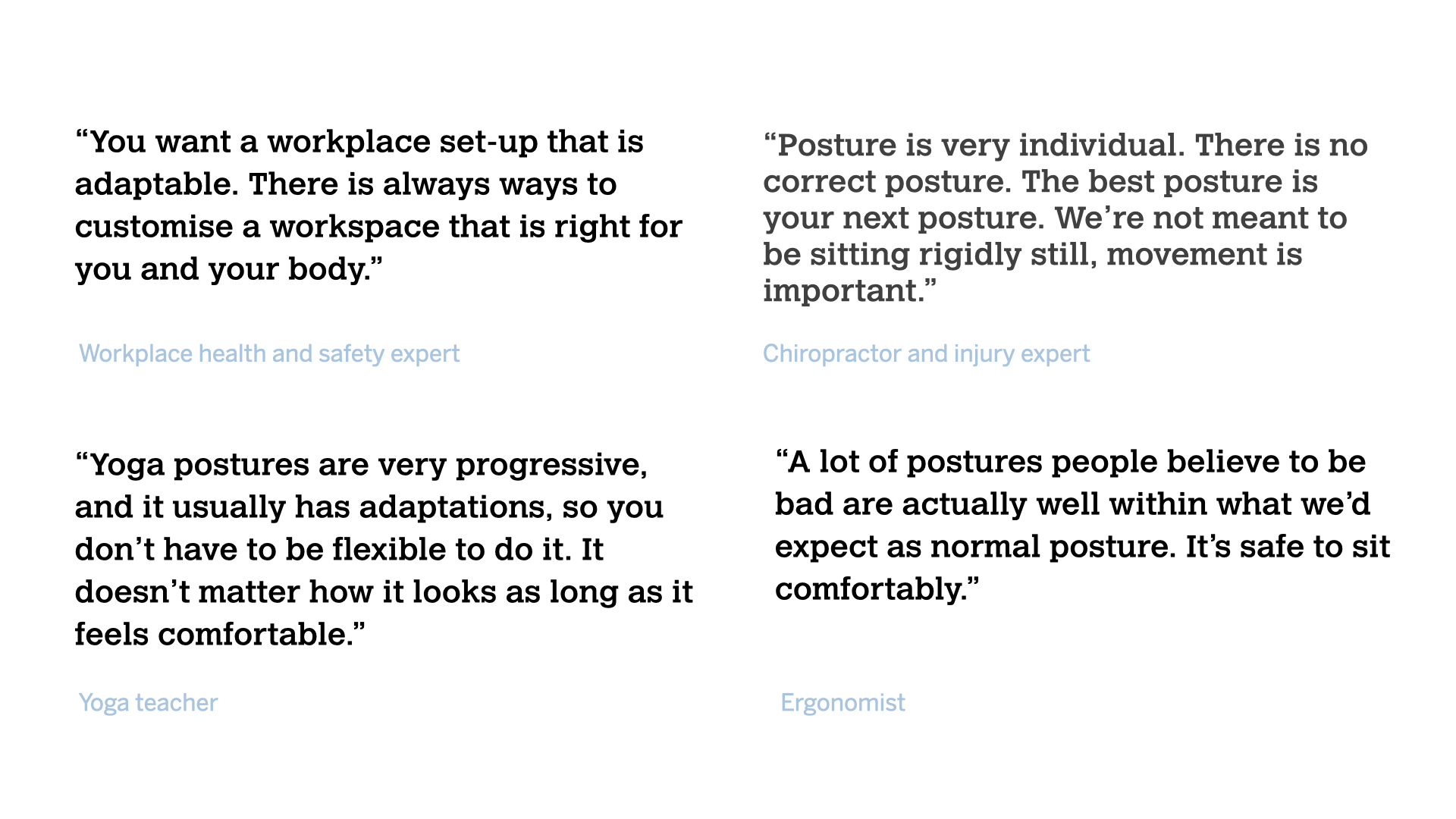
We spoke with chiropractors, back specialists, ergonomists, workplace wellbeing advisors, yoga instructors, and fitness professionals. Bringing these perspectives together helped us see the issue beyond posture alone, and understand how habits, environments, and daily work routines all contribute to experiences of back pain.
(2) User interviews
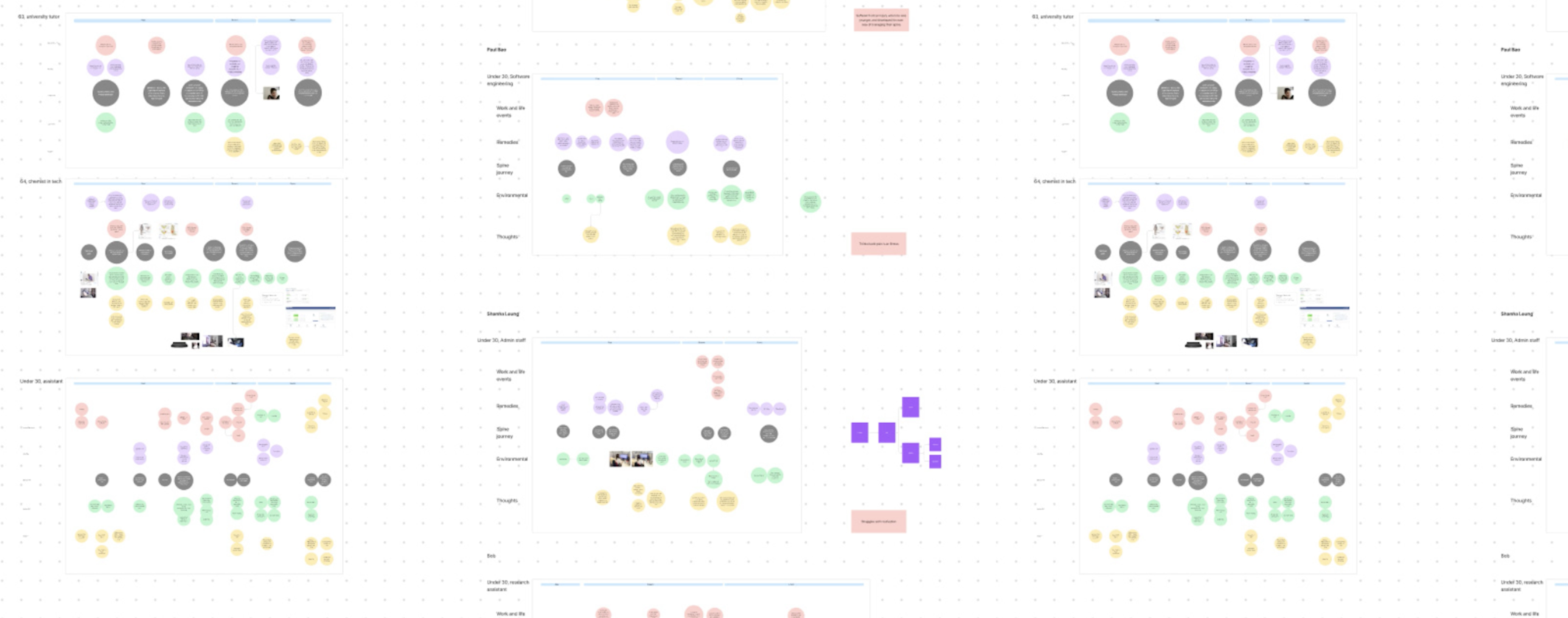
To structure the conversations, we created a mapping tool that helped participants trace their back pain journey: when it began, what was happening in their lives at the time, and what remedies they tried etc. Mapping these lived timelines grounded our design decisions in real experience rather than assumption.
Examples of quotes from interviews with Experts︎︎︎
Examples of mapping tool︎︎︎
3. Workshops
We facilitated a co-design workshop exploring how AI could be personalised and meaningfully integrated into the product experience.
The session brought together an interdisciplinary group - data scientists, fashion designers, textile researchers, and software developers. We were hoping to create an environment where technical feasibility, material knowledge and user experience all thinking in the same room.
This cross-disciplinary dialogue opened up opportunities.
Workshop at DesForm Conference, Hong Kong︎︎︎

Research Insight -> Design Intent
(1) Insight synthesis
We captured qualitative data via note-taking, conversational tools, audio-visual recordings, and photographs, before thematic analysis. The themes identified the aspects that we considered important to the context of lifestyle-related back pain.
(2) Design intent
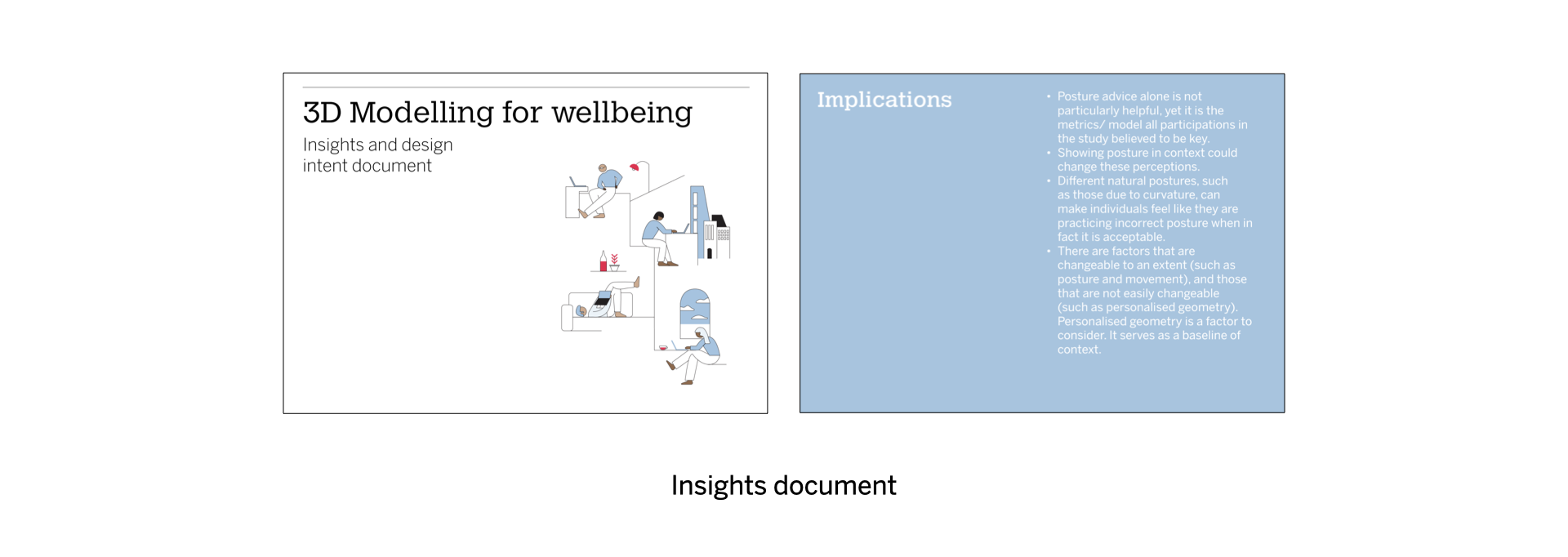
To translate research insights into design intent, we consolidated all the findings into a document ‘Insights document’, where we defined -
(3) Design outcomes
The qualitative research led to a web app concept, informed future research, and led to the final proof-of-concept prototype. View the research tool developments: Conversational Data Collection Tool or Qualitative Data Collection Tool, or the design outcome: AI for Wellbeing
We captured qualitative data via note-taking, conversational tools, audio-visual recordings, and photographs, before thematic analysis. The themes identified the aspects that we considered important to the context of lifestyle-related back pain.
(2) Design intent
To translate research insights into design intent, we consolidated all the findings into a document ‘Insights document’, where we defined -
- Who is the intervention for
- What is AI’s unique role in this intervention
- Do’s and Don’ts
- Our definitions of an inclusive intervention
(3) Design outcomes
The qualitative research led to a web app concept, informed future research, and led to the final proof-of-concept prototype. View the research tool developments: Conversational Data Collection Tool or Qualitative Data Collection Tool, or the design outcome: AI for Wellbeing
Example of Insights document detailing research insights and design intent︎︎︎
Examples of Research insight translated to Design intent︎︎︎

Insight 1 : Back pain is not just caused by posture
Many participants believe there is a single ‘good posture’ - usually upright and straight. Our research with Experts revealed that back pain at work is not only related to the straightness of the spine. Pain is influenced by movement level, psychological stress, workload, and environment. Because the causes are multidimensional, the intervention couldn’t focus on posture alone. It needed to process multiple inputs at once and respond dynamically.
Design intent: The intervention should be able to interpret multidimensional data - movement, environment, posture, and psychological stress. Traditional methods can’t manage this complexity, but AI can process large data sets, identify patterns, and make predictive insights.

Insight 2 : Inclusion requires personalisation
Some people have spines that are more skewed or curved than others - we learnt from experts that this is all perfectly natural. When it comes to giving posture advice, one size doesn’t fit all. We cannot rely on a single benchmark of “correct” posture.
Design intent : The intervention needs to respond in real time, learning from individual bodies and work habits to establish a personal baseline rather than enforcing a universal standard. AI’s capability of continuous learning could create more personalised outcomes. Image recognition could be a way to ‘see’ the person and establish baseline.
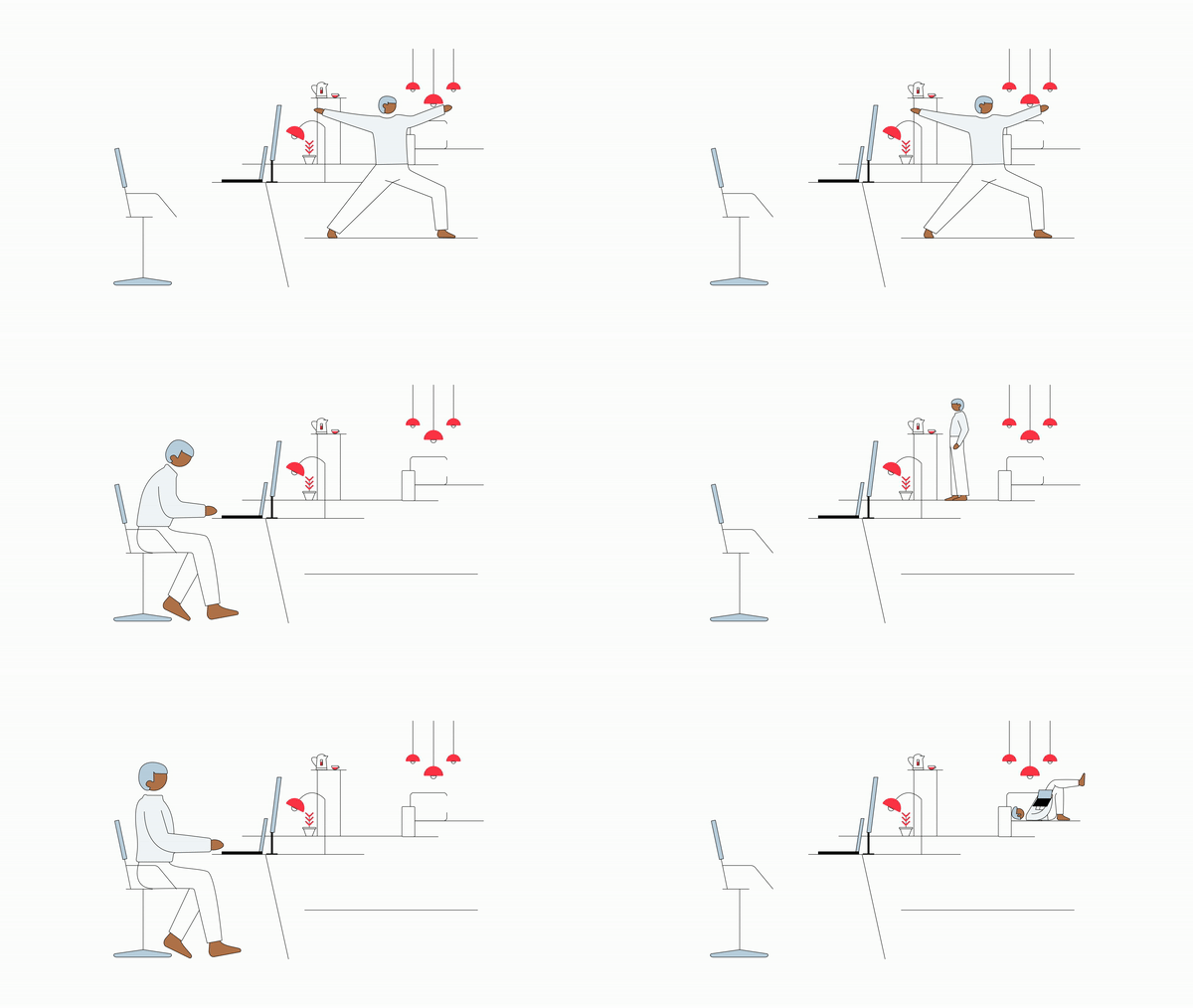
Insight 3 : Contextual advice is actionable
The workplace/ work set up varies. Some participants worked at ergonomic desks, others from sofas, on the train, etc. This means that advice that ignores context quickly becomes irrelevant. We learnt from experts that workplace advice can be fluid and often includes adaptations.
Design intent 3 : The intervention needs to be context-aware, rather than assuming a fixed workspace. This will enable relevant and actionable behaviour change. Rail-time sensing could enable guidance that adjusts to changing environments and routines.